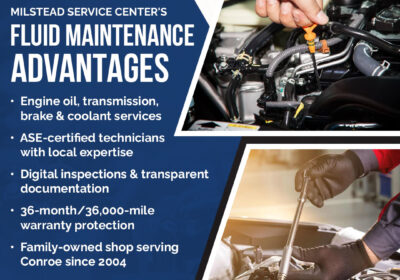


Your timing belt keeps your engine running smoothly by synchronizing the crankshaft and camshaft. Most manufacturers recommend timing belt replacement between 60,000 to 100,000 miles or every 5-7 years. Ignoring this maintenance can lead to thousands in engine damage. At Milstead Service Center, our experienced Conroe, TX, auto repair technicians provide expert timing belt services with inspections and a 36-month/36,000-mile warranty.

What Is a Timing Belt and Why Is It Important?
Understanding Timing Belt Function
The rubber-reinforced timing belt connects your engine’s crankshaft to the camshaft. The belt makes sure that the engine’s valves open and close at the appropriate intervals throughout the engine cycle, enabling the cylinders to operate and function efficiently. The timing belt has teeth that engage with sprockets on both the crankshaft and camshaft, creating precise synchronization.
The Critical Role of Timing
Without proper timing, your engine cannot function. The crankshaft moves pistons up and down while the camshaft controls valve operation. The operation of modern engines, which have several valves per cylinder, necessitates precise timing between the opening of the valves and the movement of the piston. This coordination happens thousands of times per minute, making timing belt integrity essential for engine performance.
Timing Belt vs. Timing Chain
Unlike timing chains found in some vehicles, timing belts are made of rubber and operate quietly. However, this rubber construction means they wear out over time and require regular replacement. The timing belt is located beneath the timing cover toward the front of the motor, making it invisible during routine inspections.
At Milstead Service Center, our technicians help you understand your timing belt’s condition and replacement needs. Our auto repair shop uses advanced diagnostic tools to assess your timing belt’s health during routine maintenance visits.
Factors Affecting Timing Belt Replacement Cost
Timing belt replacement involves several cost factors that vary based on your vehicle and service needs. The price range depends on several factors:
Vehicle Type Considerations
Smaller Vehicles: Passenger cars generally require less labor than larger trucks or SUVs. For cars with smaller engines, the replacement cost is typically less expensive than for larger vehicles with bigger engines.
Labor Complexity: The timing belt itself is not an expensive part. It is the time and labor required that make up the majority of the service investment. Parts of the engine have to be removed to complete the service. Labor typically accounts for 60-70% of the total investment.
Additional Components
Most professionals recommend replacing related components simultaneously, including:
Water pump – It is often driven by the timing belt and should be replaced to prevent future failures
Timing belt tensioner – Maintains proper belt tension and prevents slippage
Idler pulleys – Guide the belt along its path and ensure smooth operation
Drive belts – May need replacement during access to timing belt components
Seals and gaskets – Prevent oil leaks and maintain engine integrity
At Milstead Service Center, we provide transparent pricing and detailed estimates before beginning any work. Our inspection process shows you exactly what needs attention, helping you make informed decisions about your auto repair needs.
What Are the Signs Your Timing Belt Needs Replacing?
In most cases, a faulty timing belt will not provide a warning of an impending break. However, several symptoms may indicate timing belt problems:
Engine Performance Issues
Engine Noises: A repetitive clicking or ticking sound coming from inside the engine may indicate timing belt wear. This occurs when the belt’s teeth become worn or stretched.
Engine Won’t Start: A broken timing belt prevents the engine from starting. A worn or stretched timing belt will cause it to skip one or more teeth, and therefore, the engine ignition is prolonged.
Engine Misfires: When timing becomes inconsistent, cylinders may misfire and cause a rough idle and poor acceleration.
Other Warning Signs
Oil Leaks: Oil leaking near the motor may indicate timing belt cover problems. Worn seals around the timing belt area can cause visible leaks.
Decreased Fuel Economy: Belt wear and stretching can cause an incorrect composition of the air-fuel mixture, as the fuel is not completely burned in the chambers. This can damage the catalytic converter, which results in decreased fuel economy.
Visual Inspection Signs
The common signs that can be observed when the timing belt cover is removed include:
- Cracks along the belt surface – Indicate rubber degradation and potential failure
- Missing or damaged teeth – Cause timing slippage and engine damage
- Fraying or splitting – Show advanced wear requiring immediate replacement
- Oil contamination – Accelerates belt deterioration and reduces service life
Milstead Service Center specializes in auto repair in Conroe, TX, and can quickly diagnose timing belt issues. Our experienced technicians will identify warning signs early to prevent costly engine damage.
When Should You Replace Your Timing Belt?
Manufacturer Recommendations
The service schedules may vary depending on the manufacturer, but you should expect to replace your timing belt between 60,000 to 100,000 miles, or at the 7-year mark, whichever comes first. Always check your owner’s manual for specific recommendations.
The timing belt is made of rubber and will degrade over time regardless of mileage driven. Even low-mileage vehicles need a timing belt replacement after 5-7 years.
High-Risk Factors
Replace timing belts sooner if your vehicle experiences:
- Extreme temperatures – Texas heat accelerates rubber degradation
- Stop-and-go driving – Increases stress on timing belt components
- Dusty conditions – Contamination can cause premature wear
- Infrequent oil changes – Dirty oil can leak onto timing belt components
At Milstead Service Center, we track your vehicle’s maintenance history and remind you when timing belt service is due. Our auto repair in Conroe, TX, includes maintenance scheduling to help you stay ahead of timing belt replacement needs.
What Happens If Your Timing Belt Breaks While Driving?
Types of Engine Damage
The engine will shut off if the timing belt breaks. The severity of damage depends on your engine type:
Interference Engines
The valves and pistons crash together and bend the pistons. This can damage the cylinder head or camshaft. It can also damage the piston and cylinder wall. Repair investment can reach thousands of dollars or more.
Non-Interference Engines
The pistons and valves aren’t in the same space, so they won’t smash together if the timing belt breaks. Though there won’t be extensive engine damage, you will need to have your vehicle towed.
Immediate Effects When Driving
- Engine stops running immediately – No power to continue driving
- Power steering becomes difficult – Requires more effort to turn the wheel
- Brake assist fails – Braking requires more pedal pressure
- Vehicle momentum carries you forward – Safely steer to the shoulder or roadside
Repairing a timing belt breakage is expensive in many cases. Prevention through scheduled maintenance at an auto repair shop near you is always more beneficial than emergency repairs.
Should You Replace the Water Pump With the Timing Belt?
Many vehicles have a water pump that is driven by the timing belt. In these cases, it makes complete sense to change the water pump with a new unit at the same time, since the labor to expose the pump is being completed anyway.
Why Replace Together?
- You could save considerably in labor investment by replacing both simultaneously.
- Water pumps often fail within 20,000-30,000 miles after a timing belt replacement.
- Both components have similar service lives and replacement intervals.
- Access requires identical labor procedures – the same engine disassembly is needed.
Additional components to consider during timing belt replacement include the timing belt tensioner, which maintains proper belt tension and prevents slippage, and idler pulleys that guide the belt along its path. The drive belts may also need replacement during access to the timing belt area. The seals and gaskets, which prevent oil leaks and maintain proper engine pressure, should also be inspected and replaced if necessary.
At Milstead Service Center, our technicians evaluate each component during timing belt replacement and provide extensive auto repair services. We offer detailed recommendations and transparent pricing for any additional work needed to maximize your investment.
Milstead Service Center’s Professional Timing Belt Replacement Service
When you choose Milstead Service Center for your timing belt replacement, you receive service from experienced professionals. Our family-owned business has served the Conroe community since 2004, building a reputation for quality workmanship and honest auto repair in Conroe, TX.
Our Timing Belt Service Process
- Digital Inspection – We photograph and document the condition of your timing belt and related components
- Transparent Estimate – Detailed breakdown shows exactly what needs attention before any work begins
- Quality Parts Installation – We use OEM and high-quality aftermarket components for reliable performance
- Testing – Engine timing verification to make sure the installation and operation are proper
Why Choose Our Auto Repair Services
Experienced Technicians:
Certified professionals with decades of experience working with timing belts and engine systems. Our team stays current with manufacturer training and technical updates to guarantee proper service on all vehicle makes and models.
Advanced Equipment:
The latest diagnostic technology and specialized timing belt tools are used for precise installation and timing verification. The use of advanced technology allows us to detect potential issues before they become costly repairs.
Family Values:
Personal attention and honest recommendations for your vehicle needs, treating every customer like family since 2004. We take time to explain your service options and provide only the repairs your vehicle actually needs. You’ll never be surprised by unexpected charges or unnecessary work at our Conroe, TX, auto repair shop.
Flexible Scheduling:
Online booking and key drop-off service for busy schedules accommodate your lifestyle and work commitments. You can schedule your timing belt service at your convenience through our website or drop off your vehicle after hours using our secure key drop box. We work around your schedule to minimize disruption to your daily routine.
Professional timing belt replacement involves more than just changing the belt. When you bring your vehicle to Milstead Service Center for this critical auto repair service, our technicians perform a thorough evaluation of all timing-related components. We provide detailed recommendations with transparent pricing and expert Conroe, TX, auto repair services.

Schedule Your Timing Belt Service Today
Don’t wait for a timing belt failure to leave you stranded. Given the seriousness of timing belt failure, each vehicle with a timing belt will have a manufacturer’s guideline for when to replace the belt.
Proactive timing belt replacement protects your engine and saves money compared to emergency repairs. At Milstead Service Center, our experienced technicians provide expert timing belt services with the parts and labor warranty you need for peace of mind.
Contact Milstead Service Center today at (936) 441-3500 to schedule an appointment or learn more about our services. Trust your timing belt replacement to the auto repair professionals who go the extra mile for complete customer satisfaction. Experience the Milstead Service Center difference, where quality auto repair in Conroe, TX, meets family values.